For financial advisors who grow through CPAs, attorneys, and clients who trust them.
A book for centers of influence: who may introduce a family, what you must not promise, and when a check-in is welcome.
Start the 7-day trial Read the blog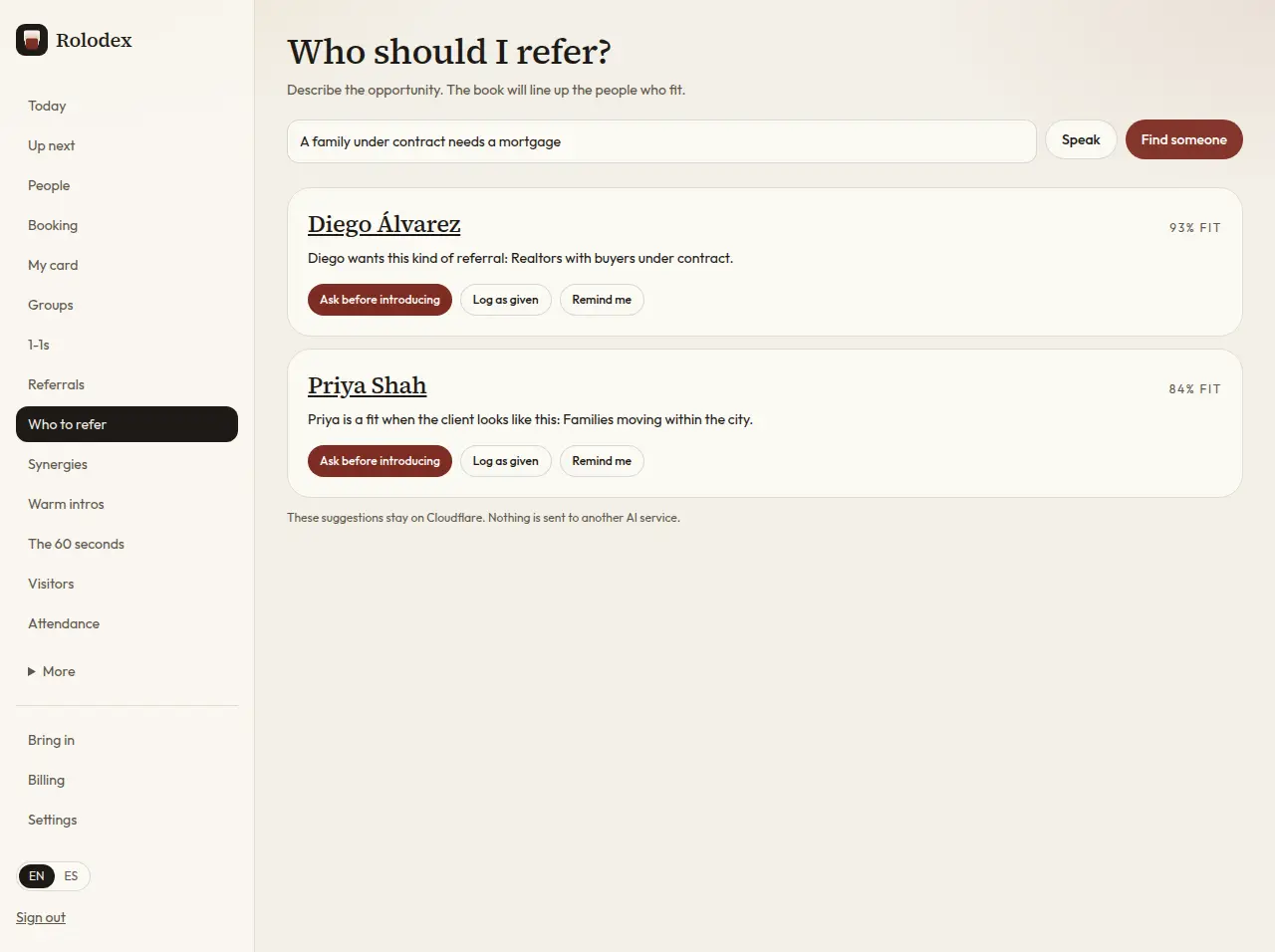
a financial advisor named Mateo does not have a lead problem. A financial advisor named Mateo has a memory problem. The useful conversations already happened: a review season in March, a card pressed into a hand, a sentence about CPAs and estate attorneys. By the next morning the detail is thinner. A week later it is a guess. Referral tracking software, a contact manager, a personal CRM: the labels differ. The job is the same. Hold the person, the promise, and the date in one place you will open again.
The concrete problem
The failure mode is ordinary. A newsletter sent to everyone feels productive while you are still in the room. It does not survive a busy Wednesday. A financial advisor named Mateo can picture the face and not the ask. That is how a warm introduction becomes a cold one, or never becomes anything. The concrete problem is not "we need AI." It is that CPAs and estate attorneys has no home except a thread you will not search.
People try to solve this with heroics. They block a Sunday and type every card. They buy a CRM because a friend on a sales team swears by it. They last two weeks. Required fields multiply. The tool starts asking for a deal size before it asks for a last name. A financial advisor named Mateo closes the tab. The cards are still in the jacket.
What is worth keeping handy
What is worth keeping is small. The name, how you met, what a good introduction would look like, and whether you owe one. For this kind of work that means centers of influence, with permission. A phone number without that context is a coin you cannot spend. A context without a date is a wish. Write both, or do not pretend you have a system.
A second thing worth keeping is the no. A financial advisor named Mateo should be able to mark that someone is not a fit, or that a referral was offered and declined, without deleting the person. Networks get kinder when "not now" is a status instead of an awkward silence. You will meet them again at a review season in March. You should not have to reconstruct the last conversation from scratch.
A worked example
Here is a week that works. On the day of a review season in March, a financial advisor named Mateo adds three people, not thirty. Each gets one line: what they do, what they asked, and a date. One of those dates is tomorrow, because CPAs and estate attorneys was specific. The other two can wait a month. Waiting on purpose is different from forgetting. The book should show the difference.
The introduction, when it happens, is a double opt-in. A financial advisor named Mateo writes to one side first: here is the situation, may I connect you. If the answer is yes, the other side gets the same courtesy. If either side says no, the referral is still real as a note. It is not a failure. It is information. Surprise CC emails feel efficient and burn trust. Do not send them.
How Rolodex fits this job
Rolodex is built for that sequence. Contacts hold the ideal referral and the ideal client. One-to-ones hold the coffee. Referrals hold given and received, with a simple status. Follow-ups wait for approval, inside quiet hours and a daily limit, and they skip anyone who unsubscribed or just replied. A card can be scanned. A QR card can be shared. A booking link can live on your own page at a path you choose. None of that requires a pipeline stage named "SQL."
A fair comparison
None of these tools is a villain. They do different jobs. The table names the job, not a winner from an ad.
| Spreadsheet | Phone contacts | A generic CRM | Rolodex | |
|---|---|---|---|---|
| Built for | Rows you maintain | Numbers you might redial | A team moving deals through stages | One person who meets people and passes introductions |
| A referral, from logged to won | A column you invent | Not a concept it has | Possible, after an admin builds it | The point of the record |
| Notes from a 1-to-1 | Another tab | A call log, if you are lucky | An activity you must remember to file | Sitting on that person |
| A follow-up you will actually send | A date that slips | Nothing | Tasks that assume a sales queue | A cadence you approve before anything goes out |
| A scanned card and a QR card | No | The camera roll, unsorted | Sometimes a paid add-on | Part of the same book |
| What you pay | Free, until it becomes a mess | Free, until the name is gone | Often per seat, priced for a pipeline | 15 dollars a month after a 7-day trial |
Price is part of the comparison, so here it is without theater. The trial is 7 days and it requires a card, so the account is real. After that, the plan is 15 dollars a month. You can cancel before the charge. There is no per-seat story because this is not a floor of representatives. If you later need a sales CRM for a team that lives in opportunities, use one. This page is for a financial advisor named Mateo, and for the problem of CPAs and estate attorneys.
FAQ
Is this only for people in a weekly group?
No. Weekly chapters, chambers, service clubs, alumni lists, and conferences all produce the same kind of promise. The book does not care which door you walked through. It cares whether you can find the promise on Thursday.
Will it email my whole list if I am not careful?
No. Check-ins default to approval. There is a daily limit, a quiet-hour window, and an unsubscribe. A campaign is a preview you can edit before it is scheduled. Nothing about this page assumes a blast.
Can I keep using a spreadsheet for the group roster?
Yes. A roster is a fine spreadsheet. The moment a row becomes a relationship, with a referral and a next note, the spreadsheet starts lying by omission. Move the people you will actually talk to.
Does Rolodex replace the organization I pay dues to?
No. Rolodex is not affiliated with any networking organization, chamber, or club. Those groups are where you show up. This is where you remember what you said you would do.
What should I do this week if I start now?
Add the ten people you would be embarrassed to forget. For each, write one line about a useful introduction. Put a date on three of them. That is the whole implementation. The rest of the product can wait until you feel the relief.
Where to go next
If this is the job you have, start with the people, not the settings. The 7-day trial is at /signup. Related reading sits on /best-referral-tracking-software and in how to track referrals. The page you are on, /for-financial-advisors, is a narrower door into the same book.
Keep going
Keep lenders, inspectors, stagers, and past clients in one book. Know who wants a buyer under contract and who just got the keys.For insurance agents, the book matters more than the slogan on the card.
Track which CPA sends owners, which realtor calls before closing, and which review is actually due. Built for introductions, not cold lists.